

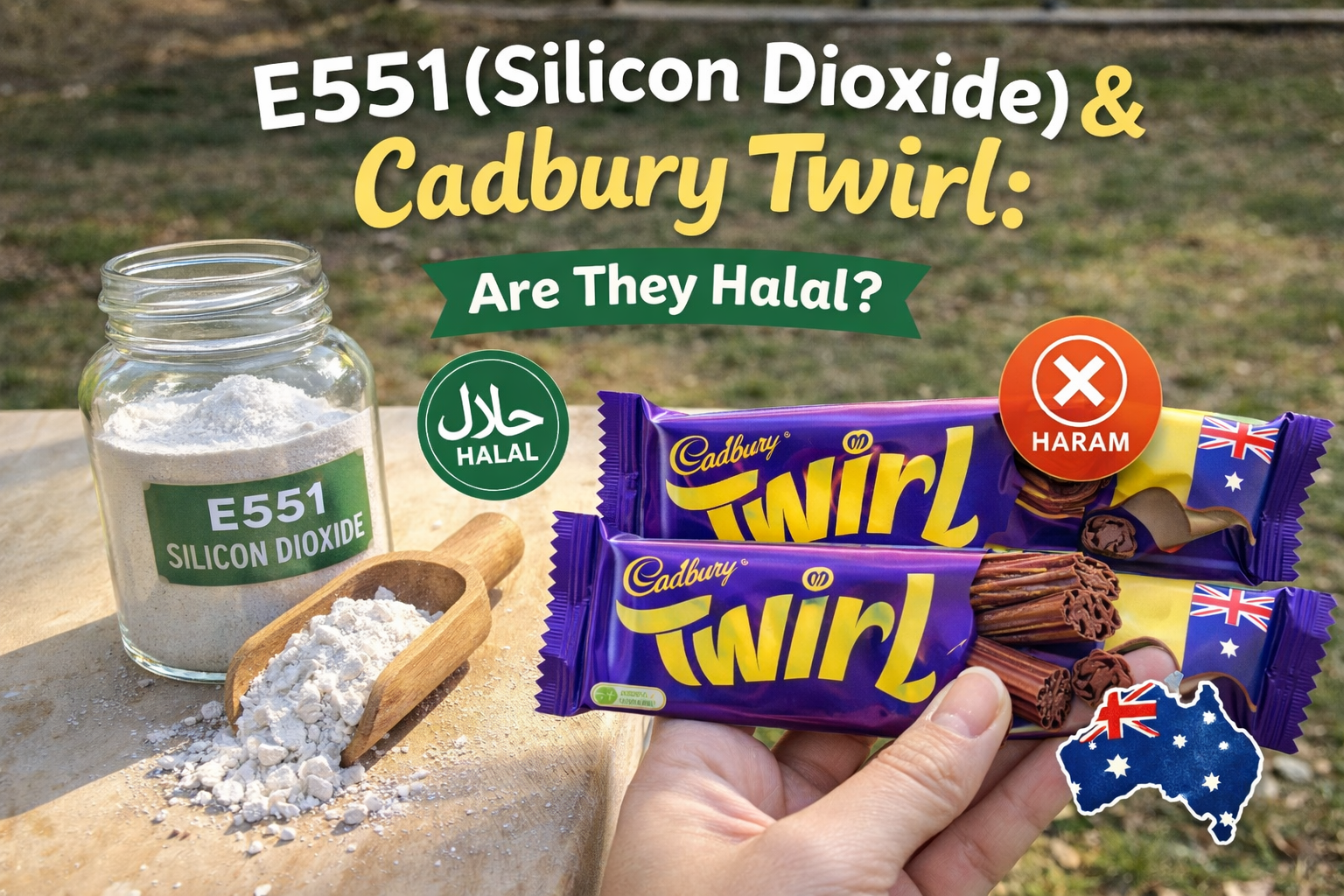
Muslim consumers often wonder about additives like E551 and whether popular chocolate bars like Cadbury Twirl are halal. In this blog, we analyze:
- What E551 is, how it’s used, and its halal status
- What evidence exists about Cadbury Twirl’s halal / halal-suitable status
- Factors and risks to check
- Steps to verify any product
Let’s start with E551.
E551 (Silicon Dioxide) — What It Is & Halal Status
What Is E551?
- E551 is the food additive silicon dioxide (also called silica) used commonly as an anti–caking agent to prevent powdered ingredients (like salt, spices, milk powder) from clumping. European Food Safety Authority
- It is essentially a mineral (silica) and not derived from animal sources.
- The European Food Safety Authority (EFSA) has re-evaluated E551 and continues to permit its use in many food products under purity standards. PMC
Evidence for E551 Being Halal
- The South African National Halaal Authority (SANHA) lists E551 as “Halaal” (safe to consume under halal guidelines) and notes its source from rocks / sand.
- E-code databases (like E-Code Verifier) mark E551 as “HALAL.”
- Food ingredient suppliers that offer halal-certified silicon dioxide claim that their product is manufactured in halal-compliant processes (i.e. no pig-derived substances, no alcohol processing). Food Chem Additive
Thus, E551 is widely accepted by halal authorities and product databases as halal.
Caveats & What to Watch Out For
Even though E551 is generally halal, consider:
- Purity and source: Ensure the batch is from a halal-certified supplier (for special / imported ingredients).
- Contaminants: If it is processed in a facility that also handles non-halal substances, cross-contamination is a concern.
- Combined additives: Sometimes E551 is mixed with other additives; those mixed ingredients must also be halal.
Is Cadbury Twirl Halal?
What Is Cadbury Twirl?
- Twirl is a chocolate bar from Cadbury (owned by Mondelez). It consists of flaked, rolled chocolate fingers coated with milk chocolate.
- Its ingredients typically include milk solids, cocoa, sugar, vegetable fats, emulsifiers, flavourings etc. MOVE HALAL
Evidence & Listings
- Halal Food Australia lists “Cadbury Twirl Milk Chocolate” under its product directory with a “halal suitable” listing. Halal Food
- Some halal or compound chocolate product websites list Twirl as halal or “suitable for halal diet.” For example, “Is Cadbury Chocolate Halal?” article mentions that Cadbury Twirl, Flake, Wispa etc. are “often halal suitable.” Halal Times
- In halal food catalogs / listing sites, Twirl appears in the product lists under halal/vegetarian categories. For instance, the Halal Food Aus blog includes Twirl among “chocolates considered halal.” Halal Food
Disclaimers & Risks
- In the UK, Cadbury has publicly stated that none of their UK products are halal certified, and they do not make special changes to make them halal. The Independent
- In 2014, Cadbury faced controversy when tests allegedly found porcine DNA in some products, and their halal certification of certain products was temporarily suspended. Research Gate
- Some websites selling Twirl in halal shops label it “not certified” but do not guarantee halal. For example, an e-halal marketplace lists Twirl with “Halal Status: Not Certified.” eHalal Marketplace
Thus, while many treat Twirl as halal-suitable, there is no universal certification guarantee everywhere.
Analysis & What You Should Do
E551 Verdict
- Conclusion: E551 (silicon dioxide) is largely accepted as halal by authorities and additive databases. Its mineral nature and lack of animal origin makes it safe under usual halal criteria.
- Best practice: When you see E551 in ingredient lists, you can generally treat it as halal — but if you see a special origin or processing note, verify that batch.
Twirl Verdict
- Conclusion: Cadbury Twirl is likely halal-suitable in many markets, especially where manufacturers use halal-safe ingredients and no non-halal additives. But it may not always be officially halal certified in every region.
- For consumers, Twirl is often acceptable, given the lack of obvious haram ingredients, but caution is needed if your local market uses different formulations.
How You (Readers) Can Verify Products
Here’s a practical checklist / method you or readers can use when evaluating E codes or chocolate bars like Twirl:
- Read the full ingredient list: check for suspicious emulsifiers (e.g. E471, E476), flavorings, alcohol, or ambiguous terms.
- Check for halal certification or logo on packaging.
- Use halal ingredient & additive databases / apps to look up additives (like E551) or product names.
- Contact the manufacturer and ask specifically: “Is this batch halal certified? Are the emulsifiers / flavorings halal-sourced?”
- Check local halal food directories or authority lists for product status.
- When there is ambiguity, be cautious: avoid if the manufacturer cannot clarify.
FAQs
Q: Could Twirl in one country be halal while in another it’s not?
Yes — chocolate formulations vary by regional supply chains. A Twirl made in Australia may use different ingredients than one made in the UK or another country.
Q: Are all E numbers halal by default?
No — many E numbers are acceptable, but some may derive from non-halal sources (animal fats, enzymes, etc.). Each must be assessed case by case.
Q: Should I avoid Twirl if it is not halal certified?
Not necessarily — many Muslims accept “halal-suitable” products if ingredients are permissible. But if you follow a stricter criterion, you may prefer only certified items.
Q: Can porcine DNA contamination happen?
Yes — as past incidents suggest. That is why halal certification / oversight is important. The 2014 Cadbury controversy is an example. ResearchGate