

Introduction
Kombucha has become one of the most popular health drinks worldwide. But many Muslims ask: is kombucha halal according to Islamic law? This blog answers that question with clarity, explaining what kombucha is, how it’s made, the role of alcohol in fermentation, and how scholars across Islamic schools of thought rule on its permissibility. By the end, you’ll know exactly when kombucha is halal and when it could be haram.
What Is Kombucha?
Kombucha is a fermented tea beverage made by combining:
- Tea (black or green)
- Sugar
- SCOBY – a symbiotic culture of bacteria and yeast
During fermentation, the SCOBY feeds on sugar and produces organic acids, carbonation, probiotics, and trace ethanol (alcohol). The process gives kombucha its tangy flavor and slight fizz, but the alcohol is naturally occurring and not added intentionally.
Why the Halal Question Arises
Alcohol is forbidden in Islam when it is intoxicating. Kombucha naturally contains small amounts of ethanol, which raises questions:
- Does this alcohol make kombucha khamr (intoxicating beverage)?
- Is trace alcohol considered haram, even if it doesn’t intoxicate?
Islamic scholars examine intoxication potential, intention, and alcohol percentage to provide a ruling.
What Percentage of Alcohol Is Considered Halal?
- Scholars do not have a fixed “Islamic percentage”, but practical guidelines exist.
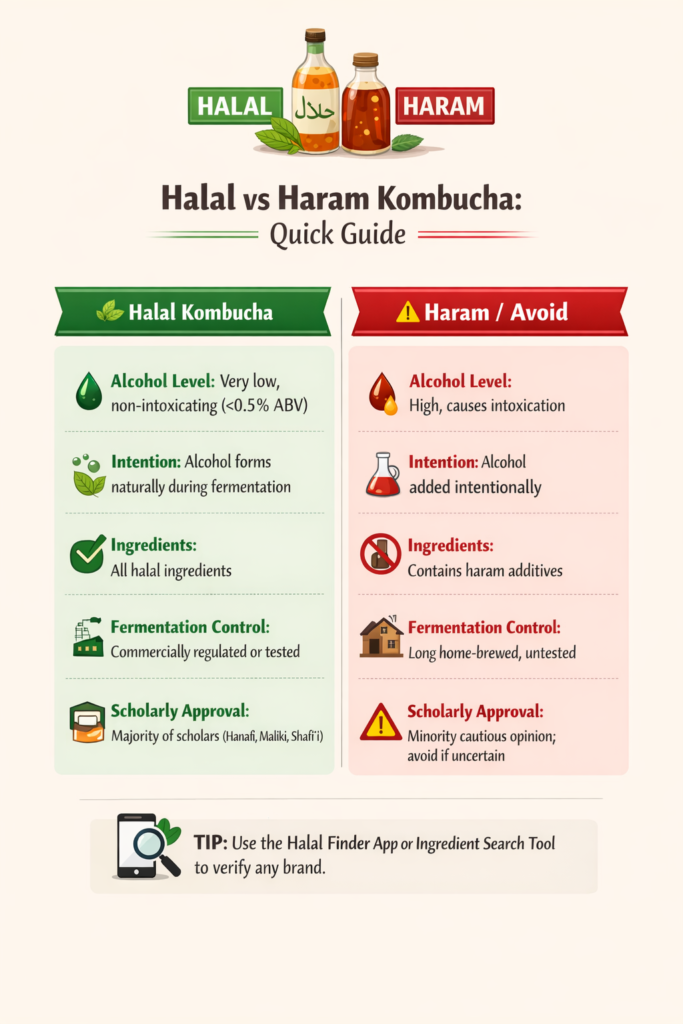
- 0.5% alcohol by volume (ABV) is commonly accepted as safe and non-intoxicating.
- Drinks below this threshold are considered non-khamr and therefore halal.
- Home-brewed kombucha may exceed this limit, making it haram or doubtful without testing.
Rule: If a beverage cannot intoxicate even in large quantities, it is halal.
Scholarly Opinions Across Islamic Schools
| School / Scholar | Ruling on Kombucha | Reasoning |
| Hanafi | Halal if non-intoxicating | Alcohol is haram only if it intoxicates; naturally occurring alcohol is excused |
| Maliki | Halal if no intoxication | Focus is on effect, not presence |
| Shafi‘i | Conditional Halal | Allowed if alcohol is minimal and not intentionally produced |
| Hanbali | Cautiously Halal | Permitted if ethanol is negligible |
| Majority Contemporary Scholars | Halal with conditions | Similar to vinegar, yogurt, and other fermented foods |
| Minority Opinion | Avoid / Doubtful | Any intentional fermentation producing alcohol is discouraged |
✅ Dominant ruling: Kombucha is halal as long as it cannot intoxicate.
When Kombucha Is Halal
Kombucha is halal when all these conditions are met:
- Alcohol is naturally formed, not added intentionally.
- Alcohol level remains very low (non-intoxicating).
- The drink cannot intoxicate, even in large quantities.
Most commercially sold kombucha meets these criteria.
When Kombucha Becomes Haram
Kombucha becomes haram if:
- Alcohol levels rise significantly (long fermentation or uncontrolled home brewing)
- The beverage intoxicates
- Haram ingredients are added
- Alcohol is intentionally increased
Practical Tips for Muslim Consumers
To avoid doubt:
- Use the Halal Finder App to verify kombucha brands
- Download the app on Apple App Store or Google Play Store
- Check ingredients using the Halal Ingredient Search Tool
- Prefer commercial, regulated kombucha
- Avoid home-brewed batches unless alcohol is tested
- Choose halal-certified kombucha when available
FAQs – Kombucha and Halal
1. Is kombucha halal according to Islam?
Yes. According to the majority of scholars, kombucha is halal if it does not intoxicate and alcohol is only a trace by-product.
2. Does any alcohol automatically make a drink haram?
No. Alcohol must be intoxicating to be considered khamr and haram.
3. Can children or pregnant women drink kombucha?
From a halal perspective, low-alcohol kombucha is permissible. For health concerns, consult a professional.
4. Is home-brewed kombucha halal?
It can be doubtful or haram if alcohol rises above safe, non-intoxicating levels.
5. How can I check if a kombucha brand is halal?
Use the Halal Finder App and the ingredient search tool to verify ingredients and compliance.
6. Is kombucha similar to vinegar in Islam?
Yes. Like vinegar, naturally fermented kombucha with negligible alcohol is considered halal.
Conclusion
Kombucha is halal according to the majority of Islamic scholars, including the Hanafi school, as long as its naturally occurring alcohol remains non-intoxicating. Most commercial kombucha fits this category, but home-brewed or over-fermented batches should be avoided unless tested.
Key Takeaway:
“If it cannot intoxicate, it is not khamr. If it is not khamr, it is halal.”